
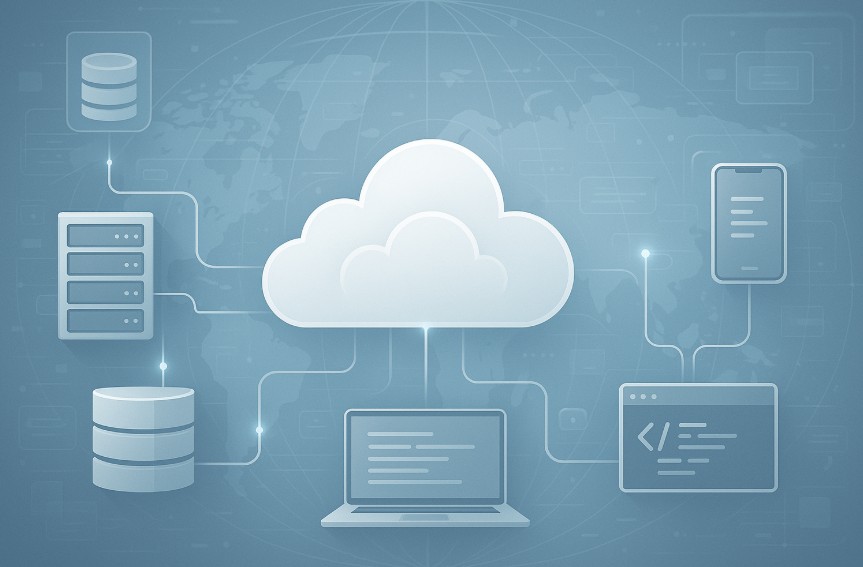
Have you ever asked yourself how modern companies manage massive amounts of data or scale their services globally with just a few clicks? The answer lies in cloud computing, a technology that has transformed the way individuals and organisations use and access digital resources.
At its core, cloud computing allows users to access computing services including servers, storage, databases, software, analytics, and more over the internet. Instead of managing physical infrastructure, businesses can now operate in a virtual environment that is more flexible, secure, and cost-effective.
This shift has driven adoption across every sector from healthcare and education to entertainment and finance. Cloud providers like Amazon Web Services (AWS), Google Cloud Platform (GCP), Microsoft Azure, and others offer services tailored to different needs, enabling scalability, resilience, and innovation.
What Are the Different Types of Cloud Computing Models?
Cloud computing isn’t a one-size-fits-all solution. There are multiple service models designed to cater to various needs:
Software as a Service (SaaS)
SaaS model allows users to access fully functional software applications through a web browser without having to manage the infrastructure behind them. The service provider handles everything—from application maintenance to data security.
Infrastructure as a Service (IaaS)
IaaS offers virtualised computing resources over the internet. Users have control over operating systems, storage, and deployed applications, while the cloud provider manages the underlying infrastructure.
Platform as a Service (PaaS)
PaaS provides a complete development and deployment environment in the cloud. It offers tools and services that support the entire application lifecycle, enabling developers to focus on writing code without managing infrastructure.
Desktop as a Service (DaaS)
DaaS virtualises desktop environments and delivers them over the internet. This model is particularly useful for remote teams and BYOD (Bring Your Own Device) policies.
Serverless Computing
Serverless computing enables developers to build and deploy applications without provisioning or managing servers. It automatically scales and only charges for the exact resources used.
Edge Computing
In this model, data is processed closer to its source (e.g., local devices or servers), reducing latency and improving performance for real-time applications.
Which Companies Are Using SaaS Cloud Computing and How?
SaaS is the most widely adopted cloud model today. Leading organisations use it for everything from communication and collaboration to customer management and data analytics.
- Salesforce revolutionises CRM by integrating AI with customer data, enabling sales teams to close deals faster and more intelligently.
- Zoom facilitates remote work and virtual meetings, storing video recordings securely in the cloud.
- Slack offers a flexible messaging platform that integrates with tools like Google Drive, Salesforce, and Dropbox, making it a hub for team collaboration.
- StreamNative, built on Apache Pulsar, offers robust data streaming solutions ideal for large-scale enterprise applications.
- OneView Commerce supports both in-store and online retail transactions through a unified commerce platform.
- VelocityEHS provides cloud-based ESG and EHS solutions for compliance and risk management.
- RunPod enables scalable AI workloads and computational processing via cloud-deployed environments.
How Is IaaS Transforming Infrastructure Deployment?
With IaaS, businesses avoid the cost and complexity of owning and maintaining physical servers. Instead, they rent infrastructure on a pay-as-you-go basis.
Examples of IaaS Providers and Their Use Cases:
| Provider | Use Case | Key Benefits |
| AWS EC2 | Scalable virtual machines for web hosting & analytics | On-demand scalability, global reach |
| DigitalOcean | App and website deployment | Fast provisioning, simple UI |
| IBM Cloud | Bare metal and virtual servers | High customisability, enterprise-grade |
| VMware DRaaS | Disaster recovery-as-a-service | Reliable data protection and recovery |
| Finix | Payment infrastructure | End-to-end payment lifecycle management |
| Zello | Real-time voice messaging infrastructure | Low-latency communication tools |
IaaS is ideal for developers, startups, and enterprises seeking agility and control over computing resources.
How Does PaaS Simplify Application Development?
PaaS platforms are designed to streamline the development process by abstracting the infrastructure layer. They include development tools, operating systems, databases, and more.
- AWS Lambda lets developers deploy code without provisioning infrastructure, responding automatically to events like file uploads or database triggers.
- Google App Engine supports multiple programming languages and automatically handles scaling and security.
- Heroku is renowned for its ease of use and support for a wide variety of programming languages.
- Eastwall assists enterprises in Azure cloud adoption with specialised consulting services.
- PagerDuty manages incident responses using real-time alerts and automated workflows.
- Acquia provides tools for developing and managing Drupal-based web applications.
- Apexon (formerly Saggezza) helps companies implement scalable Salesforce solutions.
What Are Some Effective DaaS and Serverless Cloud Computing Use Cases?
Azure Virtual Desktop allows businesses to offer secure, Windows-based virtual desktops to remote employees. Its flexibility, cost control, and deep integration with Microsoft 365 make it a go-to choice for enterprise DaaS needs.
Serverless computing, such as AWS Lambda, empowers developers to focus solely on coding. Since servers only run during execution, it reduces operational costs and increases efficiency. Companies like Netflix rely on serverless to handle usage spikes during new show launches, scaling resources automatically based on viewer activity.
How Is Edge Computing Solving Latency Challenges?
Unlike traditional cloud models, edge computing processes data closer to the end user. This is critical for services requiring near-instantaneous response times.
Cloudflare supports edge computing via a network of global edge servers, enabling applications to deliver faster performance and enhanced security. This architecture is essential for businesses such as Netflix, which uses Content Delivery Networks (CDNs) to stream video content without buffering.
Which Real-Life Companies Are Powered by Cloud Computing?
Many of today’s most successful companies owe their scalability and performance to the cloud:
- Netflix transitioned to AWS in 2016 to overcome infrastructure limitations, scale on demand, and optimise performance.
- Airbnb restructured its infrastructure using microservices for better developer productivity and service resilience.
- Uber uses a SaaS architecture to seamlessly connect drivers and passengers, handle payments, and scale operations across multiple regions.
How Is Cloud Computing Used in Data Storage and File Sharing?
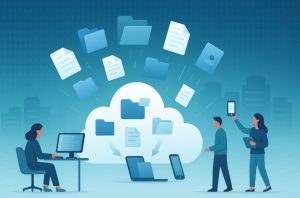
Data storage is among the earliest and most persistent use cases for cloud computing. Services like Google Drive, Dropbox, Box, and Egnyte offer secure file storage with collaboration features.
These platforms provide flexible storage plans, integration with productivity suites, and enterprise-level security. For example, Google Drive offers 15 GB of free storage per user and integrates natively with tools like Docs, Sheets, and Gmail.
What Role Does Cloud Computing Play in Big Data and Analytics?
Big data requires massive processing power and storage. Cloud computing makes it easier to store, analyse, and visualise large datasets.
- Datadog offers a monitoring platform that helps teams track real-time metrics and performance indicators across their stack.
- Collibra simplifies data governance and compliance for large enterprises.
- Civis Analytics provides customer behaviour insights using predictive modelling and machine learning.
- SPINS specialises in big data for retail and CPG companies, helping them identify trends and make data-driven decisions.
How Is Cloud Computing Enhancing Cybersecurity and Data Governance?
Security has always been a primary concern in IT. Cloud-based security platforms are now central to preventing data breaches and ensuring compliance.
- Forcepoint delivers advanced threat protection across SaaS, PaaS, and IaaS environments.
- Carbonite secures endpoints and backs up data to prevent loss and ransomware attacks.
- Zscaler offers a zero-trust network architecture that blocks unauthorised access to cloud environments.
- HUMAN uses machine learning to protect businesses against bots and fake account fraud.
- Palo Alto Networks integrates firewall and anti-malware solutions for public cloud infrastructures.
Cloud Computing Examples Categorised by Service Type and Use Case
| Category | Service Type | Company / Tool | Primary Use Case |
| Customer Relationship Mgmt | SaaS | Salesforce | CRM, sales forecasting, marketing automation |
| Video Conferencing | SaaS | Zoom | Audio/video conferencing, remote collaboration |
| Team Communication | SaaS | Slack | Messaging, file sharing, team collaboration |
| Retail Commerce | SaaS | OneView Commerce | Unified retail experience for in-store and digital platforms |
| EHS and ESG Management | SaaS | VelocityEHS | Environmental, health, and safety compliance |
| Data Streaming | SaaS | StreamNative | Messaging queues, data streaming infrastructure |
| AI Compute Platform | SaaS | RunPod | Cloud-scale AI application deployment |
| Virtual Machines & Hosting | IaaS | AWS EC2 | Cloud servers, scalable infrastructure |
| Web App Hosting | IaaS | DigitalOcean | Web hosting, app deployment, load balancing |
| Bare Metal & VMs | IaaS | IBM Cloud | Custom server infrastructure, hybrid cloud |
| Disaster Recovery | IaaS | VMware DRaaS | Cloud disaster recovery for critical workloads |
| Payment Infrastructure | IaaS | Finix | Gateway, reporting, merchant onboarding |
| Push-to-Talk App | IaaS | Zello | Real-time walkie-talkie-style communication over cloud |
| Code Execution | Serverless (FaaS) | AWS Lambda | Event-driven applications, real-time computation |
| App Development | PaaS | Google App Engine | App hosting and deployment in multiple languages |
| Multi-language Dev | PaaS | Heroku | Cloud application deployment, CI/CD pipeline |
| Azure Consulting | PaaS | Eastwall | Cloud architecture, compliance and Azure solutions |
| Incident Management | PaaS | PagerDuty | Real-time monitoring, alerting and resolution |
| Drupal Hosting | PaaS | Acquia | Managed Drupal environments, API integrations |
| Salesforce Consulting | PaaS | Apexon | CRM integration, cloud transformation |
| Remote Desktop | DaaS | Azure Virtual Desktop | Windows virtual desktops for remote teams |
| Monitoring and Analytics | Big Data / Analytics | Datadog | Application and infrastructure monitoring |
| Data Governance | Big Data / Analytics | Collibra | Cloud-based data governance and compliance |
| Consumer Analytics | Big Data / Analytics | Civis Analytics | Predictive analytics, automated workflows |
| Retail Insights | Big Data / Analytics | SPINS | Data analysis for natural products and CPG brands |
| Bot and Fraud Protection | Cybersecurity | HUMAN | Bot mitigation, ad fraud protection |
| Cloud Firewall | Cybersecurity | Palo Alto Networks | Network security and cloud workload protection |
| Zero Trust Platform | Cybersecurity | Zscaler | Secure internet access, zero-trust network model |
| Data Backup & Recovery | Cybersecurity | Carbonite | Cloud backup and ransomware protection |
| Cloud Security Platform | Cybersecurity | Forcepoint | Data protection across SaaS, PaaS, and IaaS |
| File Storage & Collaboration | Cloud Storage | Dropbox | Secure file sharing, real-time collaboration |
| Personal/Business Storage | Cloud Storage | Google Drive | Document storage, shared drives, access control |
| Enterprise File Sharing | Cloud Storage | Box | Cloud file storage with enterprise integration |
| Content Governance | Cloud Storage | Egnyte | Secure content management and threat detection |
| Global CDN & Edge Servers | Edge Computing | Cloudflare | Edge servers, web acceleration, DDoS protection |
| Streaming & CDN | Edge Computing | Netflix | Streaming media, latency optimisation with edge delivery |
| Online Learning | Education | SlideRocket | Presentation creation and sharing in the cloud |
| Typing Practice | Education | Ratatype | Online typing education and testing |
| Virtual Desktops for Ed | Education | AWS for K12 | Classroom infrastructure, student device access |
| Healthcare Cloud | Healthcare | ClearDATA, IBM Cloud, Dell | Secure medical record storage, telemedicine |
| Marketing Automation | Marketing Cloud | Maropost, Adobe, HubSpot | Lead management, campaign analytics, CRM |
| Cloud Cost Analytics | Serverless / Analytics | CloudZero | Real-time cost intelligence and usage-based analysis |
| SaaS Travel & Rentals | SaaS | Airbnb | Short-term property rental marketplace with microservices |
| Ride-sharing Platform | SaaS | Uber | Multi-tenant SaaS with real-time ride coordination |
| Enterprise-Scale Streaming | SaaS / Edge / Serverless | Netflix | Cloud-based media delivery, scaling with user demand |
Frequently Asked Questions
Is Facebook a cloud computing example?
Yes, Facebook uses cloud infrastructure to store data, images, videos, and messages that are accessible from any device.
Can I use cloud computing in small businesses?
Absolutely. Cloud computing enables startups and small businesses to access powerful tools without large upfront costs.
What’s the difference between public and private clouds?
Public clouds are shared environments provided by third-party vendors. Private clouds are dedicated to a single organisation.
Is AWS Lambda a good serverless example?
Yes, AWS Lambda is one of the most popular and efficient serverless platforms for event-driven applications.
How does the government use cloud computing?
Governments use it for shared services, IT consolidation, and citizen engagement while ensuring high security standards.
Are Gmail and Google Drive cloud applications?
Yes, both are SaaS tools that allow users to access data and services via the cloud.
Can cloud computing save operational costs?
Definitely. Cloud models reduce the need for physical infrastructure and allow flexible, usage-based billing.