
In today’s highly digitalised world, cloud computing is an indispensable tool for modern enterprises. But as businesses migrate critical applications and data to the cloud, traditional security frameworks fall short. This raises a critical question: how do organisations ensure their cloud environments remain secure, compliant, and threat-free?
The answer lies in deploying a Cloud Access Security Broker (CASB), a powerful and intelligent intermediary that enforces security policies between cloud service users and providers.
Positioned strategically between users and cloud platforms, a CASB delivers visibility, data protection, compliance assurance, and threat mitigation capabilities, enabling organisations to operate safely in multi-cloud ecosystems.
What Does a Cloud Access Security Broker (CASB) Do?
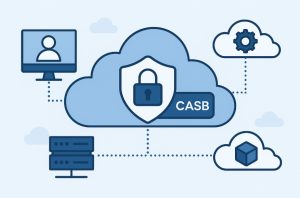
A Cloud Access Security Broker is a security layer that acts as a gatekeeper between an enterprise’s internal infrastructure and external cloud applications.
It combines various security functions, including authentication, encryption, access control, threat protection, and compliance management. CASBs are typically deployed as cloud-based services but may also be available on-premises or in hybrid formats.
CASBs provide a unified method to manage and secure access to Software-as-a-Service (SaaS), Infrastructure-as-a-Service (IaaS), and Platform-as-a-Service (PaaS) offerings.
By monitoring traffic and enforcing enterprise security policies, CASBs give IT teams control over how data is accessed, shared, and protected across all cloud services, whether they are sanctioned or not.
Why Is a CASB Necessary for Today’s Businesses?
The shift to cloud-based platforms has introduced a new level of complexity and risk in enterprise security. Employees can access corporate data from personal devices, remote locations, and over unsecured networks.
Traditional perimeter-based security tools, such as firewalls and VPNs, are not equipped to manage these decentralised environments.
This decentralisation creates gaps in visibility and control, leading to risks such as:
- Shadow IT: The unauthorised use of cloud applications outside IT’s knowledge or control
- Data breaches: Sensitive information shared via unsecured or unsanctioned platforms
- Compliance violations: Failure to adhere to industry regulations and privacy laws
- Account compromise: Unauthorised access due to stolen credentials or insider threats
A CASB addresses these challenges by providing centralised governance over cloud usage, allowing organisations to embrace cloud technology without compromising on security or compliance.
What are The Four Core Pillars of CASB Security?

Gartner outlines four foundational capabilities that define the effectiveness of any CASB solution. These pillars ensure comprehensive security coverage across all cloud environments:
How Does Visibility Enhance Cloud Security with CASB?
CASBs provide complete insight into cloud service usage within the organisation. This includes identifying both sanctioned (approved) and unsanctioned (shadow IT) applications.
Visibility is not just about discovery but about understanding the context, who is using which apps, for what purpose, from where, and how frequently.
This insight allows IT departments to:
- Analyse cloud spend and identify redundancies
- Understand data movement between users and services
- Detect risky behaviour such as excessive downloads or unusual access patterns
How Do CASBs Support Regulatory Compliance?
Cloud services can complicate compliance with regional and industry-specific regulations. CASBs help businesses meet standards such as GDPR, HIPAA, PCI-DSS, ISO 27001, and others by enforcing access controls, maintaining audit trails, and ensuring that data handling meets legal requirements.
Compliance is especially critical in sectors like:
- Healthcare (e.g., HIPAA, HITECH)
- Finance (e.g., FINRA, FFIEC)
- Retail (e.g., PCI-DSS)
How Do CASBs Ensure Data Security in the Cloud?
CASBs prevent unauthorised access to and sharing of sensitive data through technologies such as:
- Data Loss Prevention (DLP)
- Tokenisation
- Encryption
- Context-aware policy enforcement
Advanced CASBs use machine learning and document fingerprinting to recognise and protect high-risk data, such as intellectual property, personal identifiable information (PII), and financial records.
What Role Does Threat Protection Play in CASB Solutions?
From malware and ransomware to insider threats and unauthorised file sharing, cloud environments are susceptible to a wide range of cyber risks. CASBs provide proactive threat protection by:
- Scanning cloud applications for malicious files
- Detecting anomalous user behaviour
- Enforcing security protocols like real-time blocking or quarantine
CASBs act not only as detection systems but also as prevention and response mechanisms that neutralise threats before they escalate.
How Do CASBs Work?
CASBs operate by intercepting traffic between users and cloud services. They analyse this traffic to ensure that it adheres to the organisation’s security policies. Depending on the architecture, CASBs can be deployed using different models:
| Deployment Model | Description | Use Case |
| API-based | Out-of-band integration with cloud providers for scanning data at rest | Suitable for compliance monitoring |
| Forward Proxy | Intercepts requests from user to cloud service in real time | Ideal for enforcing inline policies |
| Reverse Proxy | Routes cloud service responses back through CASB for inspection | Works well for unmanaged devices |
| Multimode CASB | Combines all models for maximum coverage | Recommended for enterprises with complex needs |
These modes allow CASBs to discover shadow IT, monitor sensitive data, enforce policies, and remediate threats.
What are the Key Features and Capabilities of CASBs?
A mature CASB solution typically includes a robust set of features designed to secure the cloud environment. Some of the essential capabilities are:
| Feature | Description |
| Identity Verification | Ensures users are authenticated before accessing resources |
| Access Control | Restricts user actions based on role, location, device, or other context |
| DLP | Prevents unauthorised data exposure or leakage |
| Shadow IT Discovery | Identifies and reports usage of unapproved cloud apps |
| Threat Detection | Analyses user behaviour and content to identify threats |
| Encryption & Tokenisation | Protects sensitive data both in transit and at rest |
| Compliance Monitoring | Provides reports and ensures regulatory compliance |
| Integration with SIEM, IAM, and Firewalls | Enhances existing security infrastructure |
What Are the Primary Use Cases for CASBs?

CASBs are deployed for a variety of critical security and compliance functions:
How Do CASBs Help with Cloud Usage Governance?
CASBs help IT teams govern how users interact with cloud services. Rather than blocking apps entirely, they can allow selective usage based on criteria such as user group, device type, or risk level.
How Do CASBs Secure Data Across Devices?
With remote work and BYOD (Bring Your Own Device) policies becoming common, CASBs ensure that sensitive data is protected across all endpoints, whether users are on or off the corporate network.
How Do CASBs Manage Shadow IT?
CASBs offer insights into unauthorised applications being used within the organisation and allow IT support company to assess the risk associated with each. Based on this, policies can be set to either allow, restrict, or monitor access.
How Do CASBs Support Regulatory Compliance?
CASBs provide real-time audit trails and reporting features, allowing businesses to prove compliance during regulatory audits and to meet internal governance goals.
How Do CASBs Detect and Remediate Threats?
From detecting suspicious file sharing to isolating malware, CASBs play a central role in preventing data breaches and ensuring incident response readiness.
What Role Do CASBs Play in a SASE Architecture?
As businesses adopt Secure Access Service Edge (SASE) architectures, CASBs become a key component of Security Service Edge (SSE), the security-centric part of SASE.
In combination with Secure Web Gateways (SWG), Zero Trust Network Access (ZTNA), and Firewall-as-a-Service (FWaaS), CASBs deliver comprehensive cloud-native security.
SASE allows enterprises to move beyond traditional perimeter defences and provides dynamic, identity-aware, policy-based access to resources.
CASBs within SASE:
- Extend policy enforcement to the edge
- Enable data protection across SaaS, IaaS, and web environments
- Reduce latency while improving performance and visibility
What are the Challenges in Implementing CASBs?

While CASBs offer considerable benefits, there are challenges to consider:
- Scalability: Ensure the solution can handle your organisation’s size and data volume
- Integration: The CASB must work seamlessly with existing systems like Active Directory, SIEMs, and firewalls
- Policy Complexity: Creating accurate, non-intrusive policies takes time and expertise
- Vendor Lock-In: Opt for vendors that provide flexible deployment models and third-party integrations
These challenges can be overcome through careful planning, vendor evaluation, and phased deployment.
How to Select the Right CASB Solution?
When evaluating CASB providers, consider the following:
- Support for multiple deployment models (API, proxy, etc.)
- Compatibility with existing infrastructure
- Breadth of cloud service coverage (SaaS, IaaS, PaaS)
- Real-time policy enforcement capabilities
- Compliance and reporting tools
- Integration with SASE and SSE frameworks
Vendors such as Microsoft Defender for Cloud Apps, Netskope, Skyhigh Security, Cisco Cloudlock, Fortinet, and Zscaler offer leading CASB solutions suitable for Indian enterprises.
Conclusion: Why a CASB Is Critical in the Cloud Era?
The cloud has revolutionised how businesses operate, but it has also introduced new vulnerabilities. CASBs offer a modern, adaptive, and comprehensive approach to cloud security by providing visibility, control, and protection across all cloud interactions.
In the Indian context, where digital transformation is accelerating across industries, a CASB is not just an option, it’s a strategic necessity for enterprises looking to secure their future in the cloud.
Frequently Asked Questions
How does a CASB identify unauthorised cloud app usage?
By monitoring network traffic and using auto-discovery tools, CASBs can identify all cloud services accessed by users, both sanctioned and unsanctioned.
Can a CASB stop malware from spreading in the cloud?
Yes, CASBs can detect malware in real-time during upload or sharing and either quarantine or block infected files.
Is it possible to deploy a CASB without impacting user experience?
Most CASBs are designed to operate unobtrusively, especially in API-based deployments that do not interrupt user workflows.
Are CASBs compatible with mobile and BYOD environments?
Yes, CASBs can enforce policies across both managed and unmanaged devices, making them suitable for remote work and BYOD setups.
Can a CASB be integrated with my SIEM and DLP systems?
Yes, leading CASBs support integration with existing enterprise security tools like SIEM, DLP, IAM, and firewalls.
Do all CASBs offer threat intelligence features?
Not all CASBs are equal. It’s important to choose one that includes advanced behavioural analytics and access to global threat intelligence.
What’s the difference between CASB and a firewall?
A firewall protects the perimeter, while a CASB secures cloud applications and data. CASBs are context-aware and cloud-specific.