
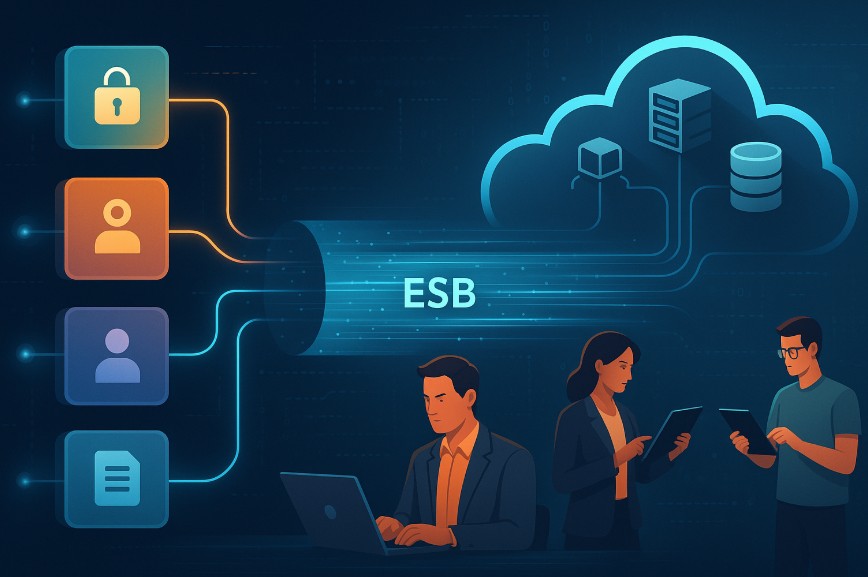
The demand for scalable, modular, and adaptable software has become the cornerstone of enterprise innovation in today’s fast-evolving digital landscape. Traditional monolithic applications, while reliable in the past, struggle to meet the expectations of modern cloud-first businesses.
In response, software architecture has shifted toward more dynamic, distributed, and flexible approaches, among which Service-Oriented Architecture (SOA) stands as one of the most significant.
SOA facilitates the creation of distributed systems built around loosely coupled, reusable components known as services. When merged with cloud computing, which offers on-demand access to computing resources over the internet, SOA’s advantages are further amplified.
This combination allows organisations to build complex applications using modular services that can be independently developed, deployed, and managed across scalable cloud environments.
In this article, we’ll explore the principles, components, implementation patterns, advantages, limitations, and future directions of SOA in cloud computing. We’ll also examine how SOA compares to microservices and where it stands in today’s enterprise IT landscape.
What is Service-Oriented Architecture (SOA)?
Service-Oriented Architecture (SOA) is a design paradigm used in software engineering where different functionalities are broken down into distinct services. These services are self-contained, reusable, loosely coupled software modules that perform specific business tasks and communicate with other services over a network.
In SOA, services interact through well-defined interfaces and communicate using open protocols such as SOAP, REST, and HTTP. A key feature of SOA is its ability to facilitate interoperability across diverse platforms, programming languages, and systems. It is particularly valuable in large organisations where different departments use different technologies but need to share data or functions.

A practical example of SOA can be seen in healthcare systems. For instance, the task of patient registration is a function required by multiple systems like appointment booking, electronic health records, and billing.
Rather than building this functionality into every system separately, SOA allows for the creation of a patient registration service that can be reused by all these systems, promoting consistency and reducing redundancy.
Why Is SOA Important?
SOA provides several foundational capabilities that are vital for modern enterprise software development. It addresses some of the core limitations of monolithic architectures, which are often inflexible and difficult to scale or modify. Here’s why SOA is significant:
- Service Reuse: Developers can avoid repetitive tasks by reusing existing services for multiple applications, saving time and resources.
- Flexibility: SOA allows organisations to adapt quickly to business changes by enabling independent modification or replacement of individual services.
- Integration-Friendly: SOA supports integration with legacy systems and newer technologies, offering an ideal framework for gradual digital transformation.
- Ease of Maintenance: Services are modular and independently deployable, allowing easier debugging, updating, and scaling.
SOA is especially valuable in environments where systems must evolve without completely re-architecting the underlying infrastructure.
How Does SOA Architecture Work in Cloud Computing?
The core principles of SOA naturally align with the cloud computing model. Cloud platforms provide scalable infrastructure and tools that facilitate the deployment, discovery, and management of services across distributed environments.
Interplay Between SOA and Cloud Computing
| Feature | SOA | Cloud Computing |
| Primary Role | Software design approach | Infrastructure and service delivery model |
| Service Deployment | Local, hybrid, or remote | Virtualised and on-demand |
| Resource Provisioning | Static or semi-dynamic | Elastic, auto-scalable |
| Access Pattern | Service-to-service | Anywhere-access over the internet |
| Ideal Use Case | Integration of diverse systems | Hosting scalable, modular applications |
SOA in cloud computing provides the structural logic, while the cloud delivers the execution environment. Together, they allow businesses to deploy reusable components in an elastic infrastructure, enabling rapid response to user demands and business goals.
What are the Core Principles of SOA?

To successfully implement SOA, organisations follow several guiding principles that promote consistency, reusability, and efficiency:
Guiding Principles of SOA
| Principle | Description |
| Standardised Contracts | Every service is defined through clear contracts (WSDL, OpenAPI, etc.) that establish expected inputs/outputs. |
| Loose Coupling | Services operate independently, with minimal assumptions about each other. |
| Abstraction | Internal workings of a service are hidden; only the interface is visible to consumers. |
| Reusability | Services are built for repeated use across applications and contexts. |
| Autonomy | Each service governs its logic, configuration, and behaviour independently. |
| Discoverability | Services are published in a registry where they can be located by potential consumers. |
| Composability | Services can be assembled into complex workflows or applications, enabling orchestration. |
These principles ensure that SOA environments remain robust, flexible, and scalable over time.
What are the Key Components of SOA Architecture?
SOA is made up of several key components, each playing a vital role in how services are created, managed, and consumed.
Components of SOA
| Component | Description |
| Service | A modular unit that performs a business task (e.g., payment processing, user authentication). |
| Service Interface | Defines how clients communicate with the service and the data formats used. |
| Service Contract | Specifies service metadata, usage rules, performance metrics, and agreements. |
| Service Provider | Hosts and maintains the service. Can be internal or a third-party vendor. |
| Service Consumer | An application or another service that invokes and uses the service. |
| Service Registry | A directory where services are published, enabling discovery and dynamic binding. |
| Enterprise Service Bus (ESB) | Middleware that handles message routing, transformation, protocol mediation, and orchestration. |
Together, these components form a dynamic and interoperable system suitable for both internal enterprise applications and cross-organisational integration.
How Do Services Interact Within SOA?
Service interaction in SOA follows a request-response model where the service consumer sends a request to a service provider through an interface defined by the service contract. The provider processes the request and returns a result.
This interaction is governed by communication protocols and standards that ensure data can be transmitted, understood, and acted upon across different systems.
What are the Common Protocols and Technologies?
- SOAP: A protocol for exchanging structured information using XML.
- REST/HTTP: Lightweight web service protocol that uses standard HTTP methods.
- JMS: Java Message Service for asynchronous communication.
- Apache Thrift and ActiveMQ : Frameworks for scalable cross-language service development.
These technologies help create a robust backbone for message exchanges across distributed service environments.
What Is the Role of ESB in SOA?
An Enterprise Service Bus (ESB) plays a central role in many traditional SOA implementations. It acts as a middleware framework that facilitates communication between different services by routing messages, transforming data formats, and managing service orchestration.
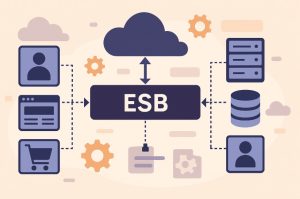
In complex enterprise environments where multiple applications need to interact with diverse systems, databases, and protocols, the ESB simplifies and centralises the integration effort. Rather than hardwiring every service-to-service connection, the ESB becomes the central hub that coordinates all service interactions.
What are the Key Functions of an ESB?
| Function | Description |
| Routing | Determines which service should receive a given request and forwards it accordingly. |
| Protocol Transformation | Converts messages between different communication protocols (e.g., JMS to HTTP). |
| Message Transformation | Translates data formats (e.g., XML to JSON) to ensure services can understand each other. |
| Security Management | Applies access control, encryption, and authentication policies across service communications. |
| Logging and Monitoring | Tracks service usage and message flow for auditing and debugging purposes. |
| Service Mediation | Abstracts the consumer from direct knowledge of the provider, offering flexibility in service replacement. |
| Orchestration Support | Coordinates a sequence of service calls to accomplish a business process. |
What are the Benefits of Using an ESB?
- Centralised Control: Simplifies governance, management, and auditing.
- Loose Coupling Enforcement: Reduces dependency between services, making changes less risky.
- Scalability and Flexibility: New services can be added without impacting the overall system.
- Interoperability: Enables integration between services using different protocols, data formats, or platforms.
Real-World Example:
A large bank might use an ESB to integrate legacy systems (like mainframes for account management) with newer applications such as online banking platforms, fraud detection tools, and third-party payment gateways. The ESB mediates between these systems, ensuring that real-time data exchange occurs securely and efficiently.
What are the Limitations of ESB?
Despite its advantages, the ESB can introduce certain challenges:
- Performance Bottleneck: Because all traffic flows through the ESB, it can become a choke point under high loads.
- Single Point of Failure: If not redundantly deployed, an ESB outage can disrupt all service communications.
- Complexity and Cost: Implementing and maintaining an ESB requires significant investment in expertise and infrastructure.
In modern, cloud-native ecosystems, many organisations are moving toward API gateways and event-driven architectures that perform some of the ESB’s roles in a more lightweight, decentralised manner. However, ESBs remain essential in traditional enterprise SOA environments with legacy system integration requirements.
What are the Advantages of SOA in Cloud Computing?
SOA in a cloud context brings a host of business and technical benefits:
- Operational Agility: Services can be deployed or replaced quickly to meet changing needs.
- Cost Efficiency: Services are reused across multiple applications, reducing duplication.
- High Availability: Redundant services hosted in different regions can ensure 24/7 uptime.
- Faster Time to Market: Ready-to-use services accelerate application development.
- Technology Neutrality: Enables seamless integration of legacy and modern systems.
These benefits make SOA particularly suitable for industries undergoing rapid transformation or requiring multi-platform coordination.
What are the Limitations and Challenges of SOA?
Despite its strengths, SOA has some inherent challenges:
| Limitation | Explanation |
| Complexity | Managing numerous services, contracts, and dependencies can become unwieldy. |
| Performance Bottlenecks | Each service invocation adds latency, especially when network calls are involved. |
| High Initial Cost | Designing and deploying a full SOA ecosystem requires significant upfront investment. |
| Security Concerns | Open protocols and decentralisation increase the surface area for potential vulnerabilities. |
| Scalability Conflicts | When many services access shared resources, bottlenecks can arise without careful design. |
These challenges are not insurmountable but require thoughtful planning and governance.
How Do SOA and Microservices Architectures Compare?
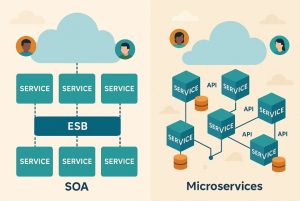
While SOA (Service-Oriented Architecture) and microservices architecture both focus on building applications through modular services, they diverge significantly in their scale, granularity, communication mechanisms, and development philosophy. Microservices can be seen as an evolution of SOA but with a sharper focus on agility, independence, and decentralisation.
What are the Core Differences Between SOA and Microservices?
| Characteristic | SOA | Microservices |
| Service Granularity | Coarse-grained (larger services handling multiple functions) | Fine-grained (single-purpose services with minimal scope) |
| Communication Style | Often centralised via ESB | Direct service-to-service or via message brokers like Kafka |
| Data Management | Shared databases among services | Each service typically manages its own database (database per service) |
| Deployment Model | Services may be deployed together or partially coupled | Fully autonomous services, independently deployable |
| Technology Stack | Often unified across the organisation | Encourages heterogeneous technology stacks (polyglot architecture) |
| Scalability Approach | Scaling is generally per application or large service cluster | Services are independently scalable based on demand |
| Fault Tolerance | Less isolated; failure in one service can affect others | Highly isolated; failures are contained within specific services |
| Service Coordination | Orchestrated using centralised control (e.g., ESB or BPM tools) | Emphasises decentralised choreography via event streams or APIs |
| Team Structure | Organised around systems or layers (e.g., frontend, backend teams) | Organised around business capabilities (e.g., cart, orders, payments) |
| Ideal Use Cases | Large enterprises integrating legacy systems | Cloud-native, DevOps-driven environments requiring high agility |
What Is the Philosophical Difference in Implementation Between SOA and Microservices?
- SOA prioritises reusability and integration, especially across complex organisational environments with diverse platforms. It suits scenarios where legacy applications need to be connected and centrally managed through middleware like ESBs.
- Microservices, on the other hand, advocate for decentralisation, autonomy, and speed. Each microservice is designed to be self-contained, deployable, and maintainable by small teams, ideally aligned with DevOps pipelines.
How Do SOA and Microservices Differ in Real-World Application?
Consider an e-commerce platform:
- In SOA, the application might have separate services for inventory, orders, payments, and shipping, all communicating via an ESB. Data might be stored in shared databases and maintained by a central IT Consulting Services team.
- In a microservices model, each domain (e.g., cart, checkout, product catalog) is handled by its own microservice, maintained by dedicated teams. Each service has its own data store and communicates using REST APIs or asynchronous messaging.
When to Use Which?
- Use SOA if you need to integrate multiple large systems, especially legacy applications, and want a governed environment with structured orchestration.
- Use Microservices if you’re building new cloud-native applications that require high deployment frequency, rapid scaling, and loosely coupled services maintained by small teams.
What are the Real-World Applications of SOA?
SOA has found extensive adoption across various industries:
- Healthcare: EHR platforms use shared services for appointment scheduling, billing, and insurance processing.
- Banking: Transaction services, fraud detection, and loan processing services integrate using SOA.
- Retail: Online platforms reuse services like inventory checks, payment gateways, and customer recommendations.
- Government: Cross-agency data exchange, tax filings, and licensing processes rely on service-based architectures.
- Telecommunications: Services for plan upgrades, billing, and user authentication run on shared service layers.
In all these scenarios, SOA simplifies complex operations by breaking them into manageable, interoperable service units.
Conclusion
SOA architecture in cloud computing is a mature yet adaptable approach to modern application design. It delivers the modularity, flexibility, and reusability needed in complex IT environments.
When combined with the scalability and infrastructure efficiency of cloud platforms, SOA enables organisations to build applications that are easier to manage, faster to develop, and more capable of evolving with business needs.
Although newer paradigms like microservices have gained traction, SOA continues to serve as a strong foundation, especially for large-scale integration projects and hybrid environments. Whether you’re migrating from legacy systems or designing new distributed applications, understanding and leveraging SOA is key to long-term software sustainability and innovation.
FAQ
How does SOA differ from traditional monolithic architecture?
Unlike monolithic systems, SOA breaks applications into independent services that can be reused, scaled, and maintained individually.
Is an ESB mandatory for SOA implementation?
No, while an ESB simplifies service integration in SOA, modern implementations may use API gateways or microservice communication patterns instead.
Can SOA be used with serverless computing?
Yes, SOA’s modular nature aligns well with serverless models where services are stateless and triggered by events.
What programming languages are used in SOA?
SOA is language-agnostic. Services can be written in Java, Python, C#, Node.js, or any language that supports network communication.
How do services in SOA communicate?
Services communicate using standard protocols like HTTP, SOAP, or REST, often exchanging data in XML or JSON formats.
Is SOA still relevant with the rise of microservices?
Yes, SOA remains relevant, especially for enterprise-level system integration, while microservices are better suited for highly agile, cloud-native applications.